Category: Uncategorized

Essential Steps for Effective Sales Closing Techniques

Closing a sale is a critical step for any business. It determines whether your efforts translate into revenue and long-term customer relationships. An effective sales strategy framework is a structured process that guides consumers in making informed decisions, addresses their concerns, and builds confidence. Following a step-by-step approach ensures consistent results and maximises the chances of success.

Understanding the Right Timing

Sales closing begins when the customer is ready to make a decision. This usually occurs when they ask questions, discuss terms, or negotiate pricing. Timing is crucial: rushing the decision may trigger resistance, while delaying too long can result in lost opportunities. A skilled salesperson knows how to gauge readiness and guide the process without pressure.

Reinforcing the Value Proposition

Revisiting the value proposition is key during closure. Aligning your product or service with the customer’s needs, challenges, and goals demonstrates genuine value rather than simply pushing a sale. By highlighting agreed-upon benefits and recalling the initial conversation, the focus shifts to solving real problems, giving the customer confidence that the solution works for them.

Handling Objections Effectively

Objections should be treated as opportunities rather than threats. Common concerns often relate to risk, pricing, authority, or timing. Sales consultants address these with empathy and clarity, uncovering the root cause and providing honest solutions. This not only helps close the current sale but also strengthens trust for future opportunities.

Building Confidence Through Evidence

Customers feel more assured when presented with testimonials, case studies, and examples. Sharing information about post-sale support and implementation steps further reduces anxiety and demonstrates reliability. Highlighting these aspects reinforces the product’s credibility and the company’s commitment to customer success.

Proven Sales Closing Techniques

Using the right technique can make all the difference. Here are some effective methods:

  • Summary Closure: Recap all benefits before seeking confirmation.
  • Trial Closure: Test readiness by asking, “Based on what you’ve seen, how does this solution meet your needs?”
  • Assumption Closure: Proceed as though the decision is already made, useful for delivery timelines or logistics.
  • Choice Closure: Offer two acceptable options to guide the customer toward a decision without overwhelming them.

Asking for the Sale

Many sales opportunities are lost simply because the salesperson forgets to ask. Confident, direct questions help the customer make a clear decision. How the sales team responds can influence the final outcome. Addressing any remaining doubts with patience and clarity ensures the customer feels supported throughout the process.

Conclusion

Sales consulting is more than a transactional step; it is a thoughtful process that creates value for both the customer and the business. When executed effectively, it builds trust, strengthens relationships, and drives sustainable success.

Strategy Management Consulting: Building Long-Term Organisational Success Through Continuous Execution

One of the key parameters of strategy management consultancy is helping organizations during uncertainties for attaining long-term success. 

Many traditional consultancies are more focused towards meeting short-term goals, whereas today, consultancies lean towards building complex structures so the execution is processed. 

Strategy as a Continuous Discipline in Management Consulting

The fundamental principle of strategy management is the notion that strategy is not a one-time phenomenon. It is a continuous process which also evolves over time. 

The leadership in all departments works in close collaboration with the strategists so the operational matters, performance management and decision-making can be aligned with the overall objectives of the organization. 

There are also ways to evaluate and track the performance of the tasks, like:

  • Analyzing strategic scorecards
  • Review strategic cycles

The analysis part is crucial because that way the warning signs can be identified and a proper action plan starts.

Aligning Internal Capabilities with External Market Challenges

The best management strategy works in two directions, i.e., 

  • Identification of the external market factors and checking the challenges in the external environment
  • Assessment of the capabilities of internal stakeholders.

Strategy management consultants do not just identify market dynamics; they take steps to regulate landscapes. Meanwhile, any technological shift over is also assessed for identification of strengths and weaknesses of the system. 

The key is to connect and integrate both internal and external factors and align with the overall goals of the organizations. 

Strategic Ownership and Overall Governance

If there are issues at the execution phase, then the issue lies in the instructions by the management. The right governance is identified and structured by the consultancy. Similarly, setting the right accountability and defining the decision making authority is also crucial for the strategic execution. 

For all these, roles at all levels need to be clearly defined, so middle management, executives, functional teams and others know what is expected of them.

Some initiatives at the strategic level are assigned clear goals with dedicated owners. Depending upon the task, timelines and budgetary requirements are also clearly defined. Such clarity is mainly the assurance of achieving success in the execution phase. 

The Critical Role of Teams in Strategy Execution

The success of any strategy is purely dependent upon its people executing that project. Strategic management consulting places utmost importance on the selection of the team, identification of the leaders and open communication for carrying out any task. 

The open and strong leadership also supports the team during resistance, conflict and negotiation matters. They assess the performance as per the laid-down criteria and reward the right person. 

Such actions are emphasized in the organizations by the strategic management consulting, because they know how to make the company successful. 

The concept of strategy consultant is not just limited to the corporate side. Many public sector organizations, educational sector, defense and healthcare industries – all are moving towards consultancy services. 

The process can save money and can help organizations to take timely and accurate decisions. Also, consultants suggest reforms, offer better marketing analysis, suggest performance systems and help in the capacity building of the workforce.

Key Qualities to Look for in a High-Performance Water Pump for Industrial Use

Key Qualities to Look for in a High-Performance Water Pump for Industrial Use

Water pumping systems are built to meet a range of requirements—whether for domestic, commercial, or heavy-duty applications. When selecting a heavy-duty pump for sectors such as pharmaceuticals, agriculture, or oil and gas, it’s essential to choose a model that’s equipped to operate effectively under the specific conditions of your industry.

When visiting a pumping equipment distributor, make it clear that you require a solution built for industrial operations. These pumps are designed to handle tougher environments, more demanding workloads, and specialised equipment.

Superior Energy Pumping Efficiency

A top-performing pump for industrial applications should also be energy-efficient. It needs to deliver high flow rates and water pressure without driving up running costs—something particularly important in sectors where maintaining consistent performance without excessive energy consumption is key.

Evaluate both the flow capacity and the pressure rating in relation to its energy efficiency. There’s no benefit in selecting an energy-saving model if it can’t meet your operational demands.

Water Pumps Built to Last

Durability is non-negotiable in heavy-duty pumping systems. When consulting with your fluid handling equipment provider, ask about the materials used in the pump’s construction. You’ll want a system made from corrosion-resistant and high-grade materials—commonly stainless steel or durable alloys—that can stand up to harsh chemicals, saltwater exposure, and extreme operating conditions.

A robust construction ensures the pump can endure high pressures and temperatures, and continue performing over time.

Dependable Pump Operation

Reliability should always be a priority. A dependable water movement system is one that has a long operational life, requires minimal maintenance, and offers straightforward servicing. Check whether it incorporates features like sealless (canned motor) designs to reduce the likelihood of leaks.

Spare parts should be easy to source, and your pump system should be designed for ease of repair and maintenance to minimise downtime. Your pumping system provider should be able to advise on which models offer the best long-term dependability.

Meets Safety and Industry Standards

A reliable pump for industrial settings must comply with all relevant health and safety standards. This includes being explosion-proof, especially if it’s to be used in hazardous or flammable environments.

Ask your industrial pumping equipment supplier to provide the unit’s pressure and temperature ratings. These figures help determine whether the pump can meet the requirements of more specialised fields such as oil and gas processing.

Versatility for Various Applications

A good pump should be adaptable enough to suit a range of conditions. Can it be modified or configured to operate in different environments, or with varying pressure demands? Also, confirm whether it’s capable of handling liquids beyond water—such as viscous or high-temperature fluids.

The more flexible your fluid transfer equipment, the better it can serve across diverse operational needs.

Pump Resistance to Corrosion

Pumps for demanding work conditions are frequently exposed to corrosive substances and aggressive media. A well-made system should be treated with protective coatings and internal linings to defend against erosion caused by debris or chemical fluids.

Alternatively, opt for units constructed entirely from corrosion-proof materials. Stainless steel is a popular choice for its ability to perform in chemically aggressive or saline environments.

Final Thoughts

When investing in a pump system for industrial use, focus on key performance factors: energy efficiency, structural integrity, safety compliance, reliability, and adaptability. A knowledgeable fluid system supplier will help guide you to the right solution—one that ensures durability, cost-efficiency, and performance in your specific industry setting.

What Are Heavy-Duty Water Pumps for Industrial Use?

What Are Heavy-Duty Water Pumps for Industrial Use

Heavy-duty water pumps built for industrial environments are designed to handle demanding tasks. With high flow rates and pressure levels, these pumps accelerate operations like draining floodwater or managing excess water during major construction works. Since each industrial setting has its own challenges, it’s best to speak with a commercial pump provider to identify the most suitable model for your site.

Core Characteristics of Industrial-Grade Water Pumps

When you approach a specialist pump distributor, they’ll generally assume the equipment is for a commercial or industrial application. These heavy-duty pumping systems are widely used in sectors like oil and gas, manufacturing, chemical processing, food production, agriculture, and wastewater treatment.

Despite the variation in use, certain features remain standard across all robust water pump systems:

  • High pressure: These pumps are built for speed and efficiency to reduce downtime, costs, and potential damage. For instance, during a flood response, a high-pressure water pump can move large volumes quickly.
  • Flow rate: Strong flow rates go hand-in-hand with high pressure. A consistent, powerful flow ensures smooth operation, especially in challenging environments involving hazardous materials or chemicals.
  • Capacity options: Industrial pumping solutions come in a range of capacities. While oil and gas sites may require large-capacity units, other sectors can perform well with smaller, cost-effective models.
  • Durable materials: The right commercial pump supplier will recommend materials suited to your working conditions. Stainless steel, for example, is ideal for resisting corrosion in exposed or chemical-heavy environments.
  • Energy efficiency: While these pumps are powerful, many modern versions are designed with energy-saving features. Reducing electricity use is essential for cost control, and suppliers often promote energy-efficient systems to appeal to budget-conscious businesses.

Common Types of Pumps for Industrial Use

There are multiple kinds of heavy-duty water pumps tailored for industrial settings. A knowledgeable pump supplier can guide you through the best choice based on your specific requirements. Below are the most commonly used models:

  1. Centrifugal Pumps

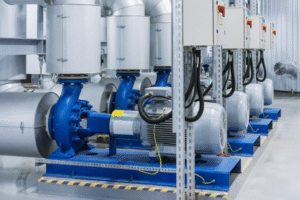
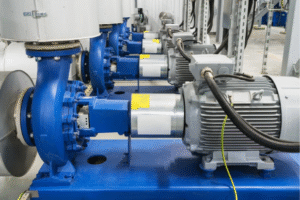
These pumps operate using centrifugal force to push water or other liquids through systems. Known for their straightforward design and versatility, they are easy to maintain and don’t require specialised expertise for routine servicing. Centrifugal units are widely employed in sectors such as agriculture and municipal water treatment.

  1. Positive Displacement Pumps

Unlike centrifugal pumps, these systems move a fixed volume of fluid with each cycle, using pistons or gears. They create a steady flow regardless of the fluid’s thickness, making them well-suited for oil and gas applications. This type of unit is ideal when dealing with viscous or abrasive fluids.

  1. Peristaltic (Tube) Pumps

Often used in pharmaceutical and food processing environments, peristaltic pumps work by compressing a flexible tube with rollers. The liquid never contacts any moving mechanical parts, reducing the risk of contamination or internal wear. If your work involves sterile conditions or corrosive fluids, a technical pump distributor will likely recommend this type.


Choosing the Right Industrial Pump System

Finding the right heavy-duty pumping unit is only the beginning. Working with a reliable industrial pump specialist ensures you get expert guidance tailored to your specific industry, risks, and performance needs. The right advice can help you select a durable, efficient system that meets the demands of your operation.

How to Maximise the Lifespan of Water Pumps in Remote Industrial Sites

How to Maximise the Lifespan of Water Pumps in Remote Industrial Sites

One of the major challenges energy companies face when sourcing heavy-duty pumping equipment is that many of their operations are located in remote or off-grid areas. In these environments, access to support is limited. If a pump fails, replacing or repairing it quickly is often not an option.

That’s why firms in the oil and gas sector prioritise durable, dependable pumping systems. Beyond choosing the right equipment, they also take proactive steps to extend the service life of water transfer pumps and keep operations running smoothly.

Here are some proven strategies to increase the longevity of industrial-grade water pumps:

1. Choose the Right Pumping System

Before investing in a industrial-grade water pump, conduct a thorough assessment of the site. Consider water quality, environmental conditions, and potential risks that could affect equipment performance. This allows the equipment provider to recommend a suitable pump design for that specific location.

The choice of materials and pump configuration is crucial. For example, high-capacity centrifugal pumps are often ideal for applications requiring consistent, high-volume flow rates.

2. Protect Against Weather Conditions

Pumps used in industrial settings must be protected from harsh environmental conditions. Weatherproofing by the pump manufacturer helps safeguard the system from extreme heat, cold, moisture, and airborne particles.

This protection extends operational life and minimises the likelihood of weather-related malfunctions.

3. Ensure Correct Installation

Proper setup is critical to the reliability of heavy-duty pumping equipment. Position the pump in a stable location to avoid vibration-related damage. Mounting it securely helps reduce unnecessary wear and tear over time.

In many cases, placing the pump in an enclosed shelter or protective casing shields it from wind, precipitation, and debris – all of which could shorten its lifespan.

4. Follow a Routine Maintenance Schedule

Routine maintenance is non-negotiable, particularly in remote locations where downtime is costly and spares may be hard to source.

Clean filters regularly, especially in dusty or sandy environments. Lubricate all moving parts to avoid friction-related damage, and inspect seals for leaks. Replacing worn seals early can prevent major breakdowns.

5. Use Remote Monitoring Technology

To offset the lack of on-site support, equipment vendors can offer remote diagnostics and monitoring systems as part of their aftercare service. These use smart sensors to track vital data like flow rate, temperature, pressure, and vibration levels.

Using Internet of Things (IoT) technology, the system can detect early signs of failure and alert the operator before a serious issue develops. Some setups even include automated shutdown features to prevent further damage.

6. Secure a Reliable Power Source

Power reliability is another critical concern in remote operations. Frequent outages or unstable voltage can seriously disrupt pump performance.

Backup energy systems such as diesel generators or solar arrays ensure continued operation. Voltage stabilisers are also recommended to protect sensitive pump components from power surges or drops.

7. Manage Water Quality

The quality of the water being pumped plays a significant role in system durability. Filtration systems can prevent grit, sand, and other contaminants from damaging the internals of the pump.

Where possible, treating the water to reduce scaling, corrosion, or microbial growth can also improve performance and reduce long-term wear.

Final Thoughts

By selecting appropriate pumping solutions, working with experienced equipment vendors, and implementing robust protection and maintenance strategies, energy companies can maximise uptime and reduce costs.

These approaches help ensure that industrial pumping equipment remains reliable – even in the toughest, most remote field conditions.